"I don't mix mutations." -Really?
This sentence comes back like a boomerang in relation to breeding ethics. Every time I hear “I don’t mix mutations”, it tells me more about the person who says it rather than about the basic genetic knowledge that person supposedly has.
A domestic cat has 38 chromosomes, around 19,500 protein-coding genes packed into around 2.5 billion base pairs of DNA. This is the genetic structure of every cat that you have ever seen. A 2024 review summarising OMIA data indicated 197 DNA variants in the cat including around 45 phenotypic variants and around 140 variants associated with diseases, blood type, or other traits.
The word "mutation" itself has become some kind of "bad" word in the breeding community and to a large extent is associated with something harmful or unnatural. A mutation is simply a change in the DNA sequence. Some mutations are harmful, some are neutral, and some are beneficial. Most do not negatively affect health at all. Without mutations, there would be no evolution, diversity, breeds, colours, patterns, hairless cats or life on this planet. So when someone announces that in their ethical code "mixing mutations" is a "no-no", a "red flag" and "unethical", I have to ask then: what exactly in your opinion are you breeding?
Mutations are not limited to what can be seen. They reach much deeper than colour or coat type. Whole-genome analysis of domestic cats shows on average around 9.6 million single nucleotide variants per cat. But even if we narrow the subject to what can be seen with the naked eye when looking at a cat, then we see there exactly a mix of different mutations.
Hairlessness is a mutation in KRT71, chocolate is a mutation in TYRP1, cinnamon is a different mutation in the same gene. Dilution is a mutation in MLPH, orange is a sex-linked mutation in ARHGAP36, point is a temperature-sensitive mutation in TYR, Burmese colour restriction is a different mutation in the same TYR gene. Dominant white is a mutation in KIT, white spotting is a different mutation also in KIT. Non-agouti is a mutation in ASIP, classic blotched tabby is associated with the Tabby locus, currently identified as LVRN, while tabby patterning more broadly involves multiple loci. Long hair is a mutation in FGF5, with at least four different variants across different breeds, folded ears are a mutation in TRPV4,taillessness and short tail in cats can arise from different variants, including TBXT in Manx-type taillessness and HES7 in some Asian short-tailed lines, and extra toes are a mutation in the SHH regulatory region.
Now let's check how things look in practice.
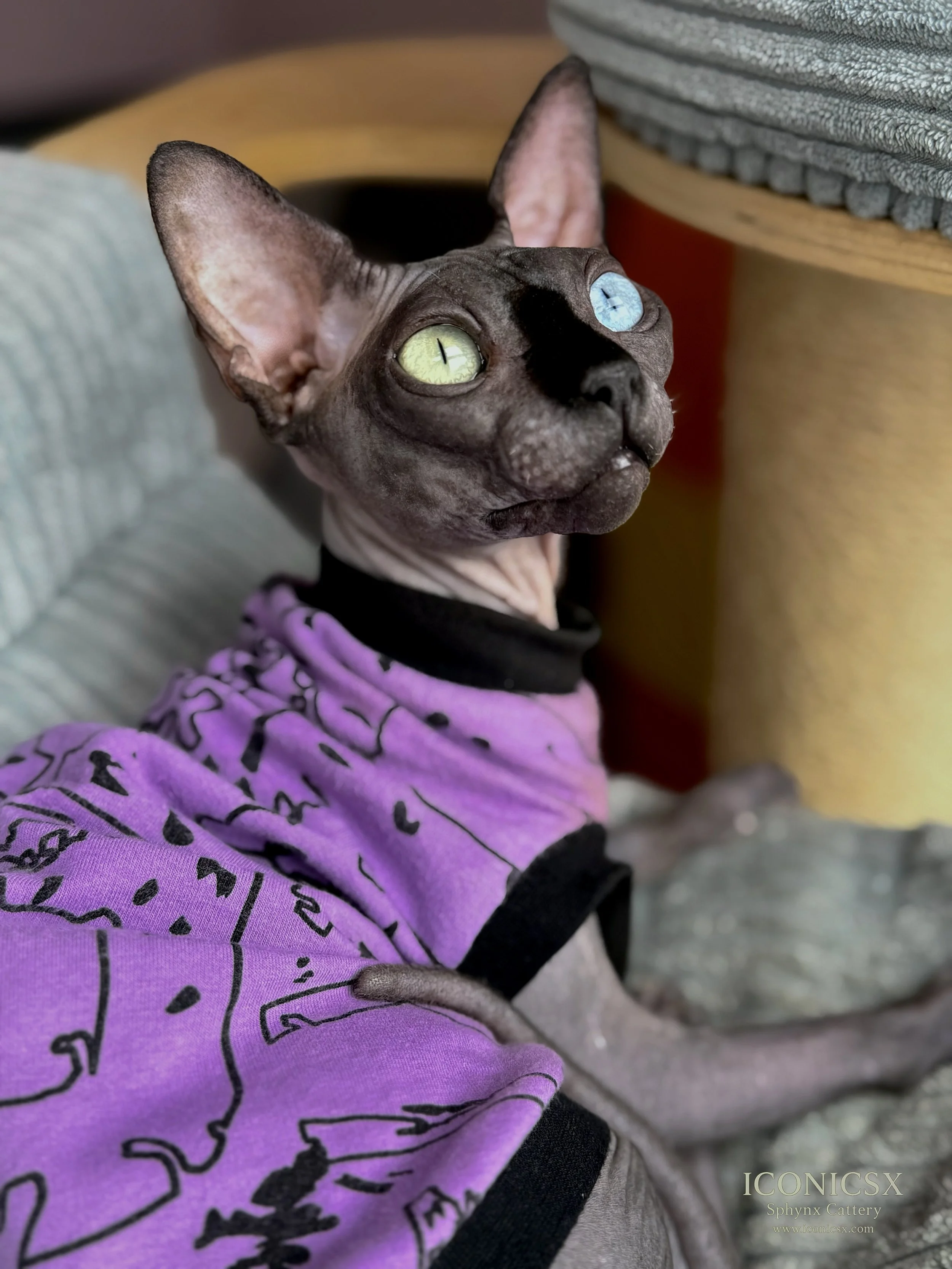
We can take two blue calico blue-eyed Sphynx cats with the same visible end result, but produced by 2 different genetic variants: KIT and DBE-CEL.
The first one would carry hairlessness in KRT71, dilution in MLPH, orange in ARHGAP36, non-agouti in ASIP, and white spotting in KIT. That is 5 visible mutation variants.
Nobody counts the mutations here, nobody questions the ethics.
Now check the 2nd cat with DBE-CEL instead of KIT: hairlessness in KRT71, dilution in MLPH, orange in ARHGAP36, non-agouti in ASIP, and DBE-CEL. Also 5.
So, we have the same number of mutations, but somehow the problem starts when a rare mutation occurs in other lines than yours, and then the 2nd cat suddenly becomes a "mixed mutation" entity.
So my next question now is what about the mutations you cannot see? Mutations responsible for blood type, heart function, kidney function, neurological development, immune response, susceptibility to disease, all of this is regulated by genetic variants completely invisible without testing.
Many of them can be devastating, some can shorten life or kill. A significant part is passed on to further generations and nobody is worried about mixing the invisible mutations together. Nobody talks about ethics when two carriers are bred together, when cats with known dominant genetic burden are used for breeding. The majority do not test beyond breed-specific genes, some breeders are even brave enough to write in public that they are comfortable with them in their breeding programme. Nobody questions their ethics, there are no posters shared on social media to make buyers aware.
So what is the real problem?
Mixing mutations is not the problem. Every cat on this planet is a mixture of mutations. The question that really matters is: which mutations are being combined, how they work, what they do, and what the documented scientific material says about their safety. That is the only question a responsible breeder should be asking and looking into.
And here the embarrassing part comes out. Inheritance, mutations, dominant and recessive genes, Punnett squares, sex-linked traits, this is GCSE Biology in the United Kingdom. They teach this to 14-16 year olds. In Poland, where I come from, it starts even earlier.
"I don't mix mutations" shows functional genetic illiteracy, and when combined with ethics, it becomes a performance of ethical superiority based on nonsense.
"I don't mix mutations" becomes a commercial message; one that flatters the author, omits equivalent facts concerning their own cats, and at the same time discredits the competition.
#CatGenetics #BreedingEthics #ResponsibleBreeding #GeneticLiteracy #EvidenceBasedBreeding #DBE #ScienceNotSlogans #FactsOverFear