Eye Colour Development in Cats
From Newborn Blue to Adult Colour, Odd Eyes and DBE
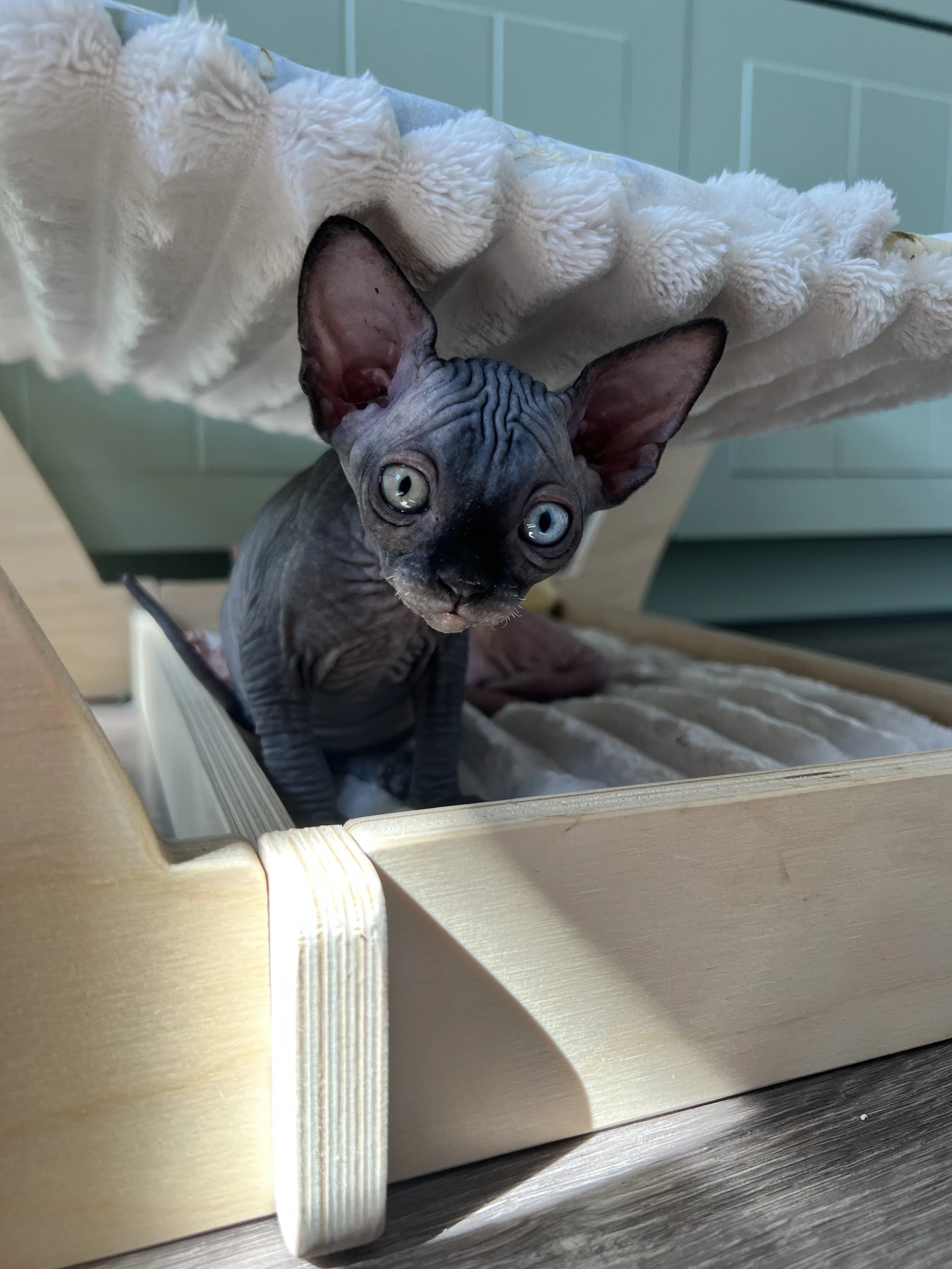
All kittens are born with blue eyes.
All kittens are born with blue eyes, whatever colour they will end up as. This is normal, and it is not a sign of DBE or proof of anything.
The reason is optical, not genetic. At birth the iris contains almost no melanin, so there is no pigment to give it colour. Instead, light scatters against the collagen fibres of the iris stroma and the shorter (blue) wavelengths are reflected back — the same effect that makes the sky look blue. The eye looks blue because it is empty of pigment, not because blue pigment is present.
How true eye colour develops
Eye colour comes from melanocytes — pigment-producing cells — in the iris, and from how much melanin they deposit. Little melanin gives green or yellow; more gives amber; a lot gives copper or brown. The colour is set by the amount and distribution of pigment, not by the structure of the eye.
The timeline is gradual:
Birth: eyes closed; no iris pigment.
~7–14 days: eyes open; still blue, vision still developing.
~3–6 weeks: melanocytes begin depositing melanin; colour starts to shift.
~3–4 months: adult eye colour is usually settled.
Because the colour develops over months, a young kitten's eye colour tells you very little about its final colour — and its newborn blue tells you nothing about its genetics.
Where DBE is different
This is the key point that sets Dominant Blue Eye apart. A newborn kitten's blue comes from absence of pigment. A DBE cat's blue is different: it results from a PAX3 variant that affects how pigment cells develop, producing blue or odd eyes that persist rather than changing to a pigmented colour.
So there are two completely different reasons a cat can have blue eyes: the temporary, pigment-free blue that every kitten starts with, and the genetic blue of a DBE variant. They look similar in a young kitten but arise from entirely different biology — which is exactly why you cannot tell them apart by eye in a newborn.
Odd eyes and heterochromia
Because eye colour depends on where and how much pigment is deposited, uneven pigmentation produces variations:
Odd eyes (heterochromia iridum): one iris fully pigmented, the other blue.
Sectoral heterochromia: part of a single iris blue, the rest pigmented.
These can occur in DBE cats, but odd eyes are not unique to DBE — reduced or uneven iris pigment can arise from more than one cause. As with solid blue, appearance alone does not identify the underlying genetics.
A note on the "flash test"
Because a newborn kitten's eye is still developing, some breeders photograph kittens with a flash and read the red "reflex" as proof of DBE — one red eye for odd-eyed, two for blue, and so on.
This does not work. In a young kitten the tapetum lucidum (the reflective layer that makes adult cats' eyes glow) is not yet mature, so a flash reflects off the back of the eye and can appear red — in any kitten, regardless of eye colour or genetics. The same kitten can show one red eye in one photo, two in another, and none in a third. A result that changes with angle and lighting cannot identify a gene.
There is also no reason to do it. A newborn's eyes are immature and light-sensitive, and a flash reflex proves nothing about DBE in the first place. The only reliable way to identify a DBE variant is a variant-specific DNA test, alongside letting the kitten's true eye colour develop over its first months.
Lucchi 1978 i Wolff 1968 .
Bergmanson 1980
Coles 1971
References: