Cat Enrichment
Why Cat Enrichment Matters — Especially for Indoor Cats.
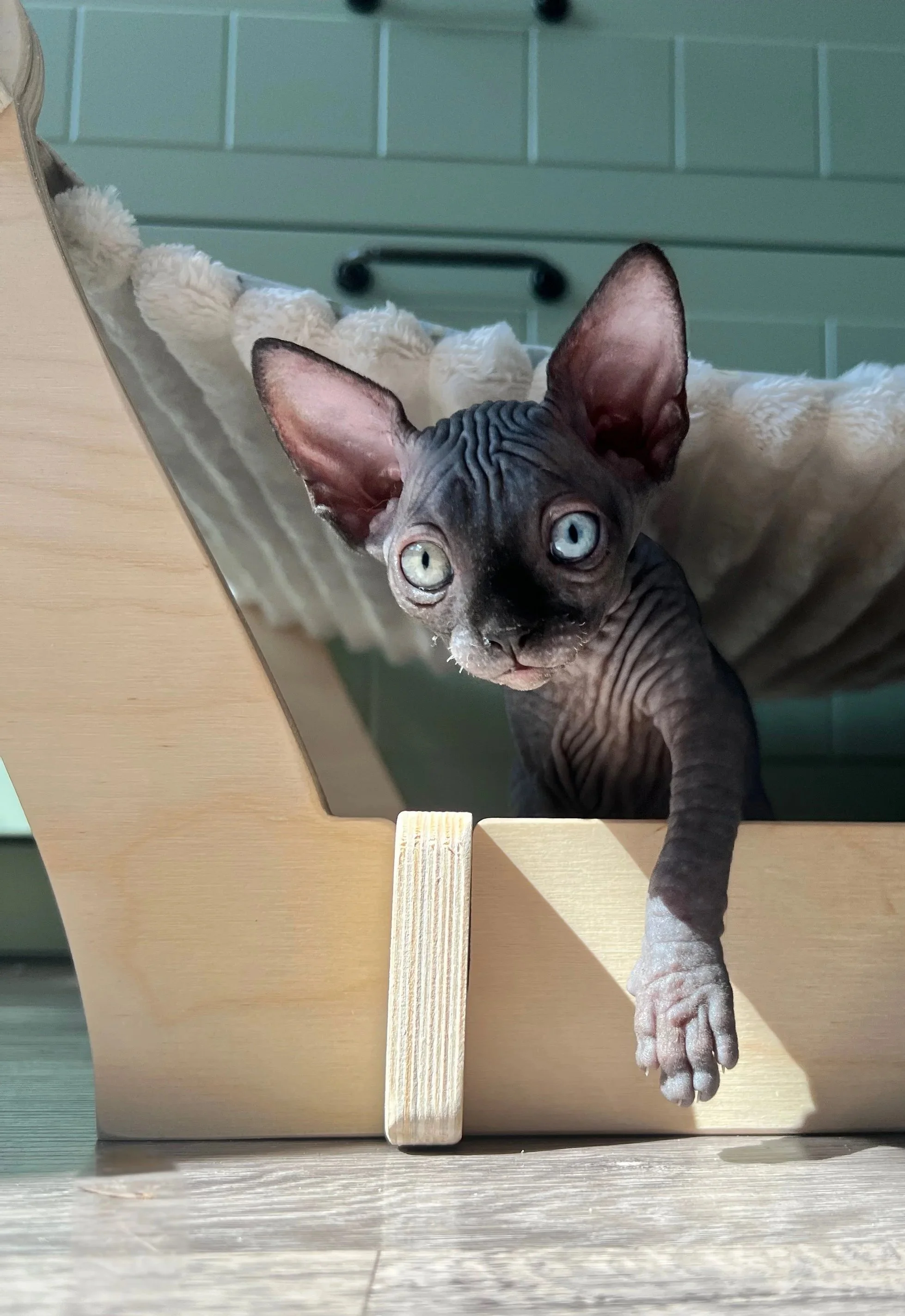
If you have ever lived with an indoor cat you have probably asked yourself whether you are giving enough, whether that single cat tree in the corner is doing anything at all, and what actually matters when it comes to keeping a cat balanced and secure.
Vertical and Horizontal Space.
Vertical and horizontal space is not decoration, it is structure, and you can put the tallest tower in the room but if it wobbles once or stands isolated with nowhere to go the cat will not use it again because they do not care how it looks to us, they care whether it works and whether it is safe. Cats scan every room for the same answers, where can I move, where do I sit, where is the exit, and if those answers are unclear stress begins long before you notice it. Height means safety because it offers a clear view and the option of a fast escape, while horizontal routes mean choice because they allow passage without cornering. They map every move and every landing; a tower that wobbles once is erased from the map, a shelf that leads nowhere becomes dead space, and a structure that links one surface to another and holds steady becomes part of the daily route, a place to move and to rest and to plan. Horizontal does not only mean floor space, it is the top of a radiator, the back of a sofa, a hammock that connects two shelves, anything that links one point to the next; if the route makes sense, up then across then down without strange gaps or dead ends, the cat will use it fully. In multi-cat homes you see the difference in how they pass each other without confrontation, each taking a different height and distance so the chase never begins. The rule is simple: stability first.
Texture, Light, Scent, Sound and Sight.
Cats do not simply walk through a room because they scan it and they do it without pause, and you may think nothing has changed while they pick up on tiny shifts immediately and choose to leave rather than wait to see if it improves. For most cats texture registers first because it is the fastest way to judge whether a place is safe; rough, soft, warm and cold are noted before they even lie down, and some cats melt into fleece as if they have been holding tension all night while others refuse to settle unless the surface under their paws feels solid and steady, and when you change the texture you see the change in the cat. Light works in much the same way because it is not just comfort but information; they watch how shadows move and whether a corner flickers, and I have seen entire areas avoided because the light behaves strangely while the same cat will choose a plain window with steady daylight over the most elaborate tree. Scent is always there in the background, with catnip, valerian and silvervine all useful in moderation, but anything left out constantly fades to nothing, so one toy in one area and then remove it to reset interest is more effective than a permanent supply. Sound plays a similar role because cats do not need silence so much as consistency; a steady hum from the fridge or distant traffic falls into the background, but one buzzing plug near a bed or a single loud slam can end their trust in that spot completely, while natural sounds like birds and wind tend to blend in. Sight ties it all together because every flicker and reflection is noticed, and routines such as watching the same branches and birds from the same place each morning often set the tone for the day. None of this is about decoration because you can make a room look perfect to you and still miss what matters to them, and their senses make the decision, not yours.
Movement and Play.
From a behavioural point of view movement is not optional because it is the way cats regulate both their body and their mind; they are predators by design and the cycle of stalk, chase and catch is always waiting to be played out, and when that drive has nowhere to go it leaks into the house as restless pacing, claws in furniture or midnight sprints. Structures matter because each one answers a different part of the cycle. A wheel gives what no room can offer indoors, which is distance, and if the wheel is too small the spine bends the wrong way and if it wobbles they will not touch it again, but when it is strong and wide enough they stretch properly, run flat and settle into a rhythm that feels safe so trapped energy is released instead of turning into strain. Tunnels work for a different reason because they are about strategy rather than speed, they provide cover and a place to disappear and reappear and plan an ambush, and if the tunnel slips under their weight it is written off, but if it holds steady it becomes part of the cat’s regular routes. Solo hunts close the loop because a chase without a finish only leaves frustration, so food folded into paper, treats tucked into boxes or puzzles they can solve provide the small win that resets the body; without the catch there is no relief, with the catch the muscles relax and the sleep that follows looks different. Laser play proves the same point because the light cannot be caught, so it must end with something real in the mouth or under the paw. In homes with more than one cat the effect multiplies as a wheel burns energy, a tunnel gives cover, a puzzle absorbs focus and the room shifts into calm.
Personal Retreats.
Safety is not just the absence of threat, it is the knowledge that there is always a way out when things get too much, and cats live with both sides of their nature at once so you see it every day: a door closes too quickly and they jump, someone enters the room in a hurry and they vanish, two cats meet in a hallway and the first thing they do is look for a place to retreat. When that space is missing, stress shows up as behavioural problems, most often spraying outside the litter box, sudden scuffles that seem to come from nowhere, or a cat that withdraws completely and refuses to engage. The safe spot does not need to look attractive to us because it is not about appearance but about what it provides; it can be the space under a bed, a carrier left open in the corner, a high shelf that only the cat can reach, or even a simple cardboard box that looks like nothing to us but functions as a control centre for them, a place to disappear, to watch quietly, and to return when they feel ready. In multi-cat homes the effect is immediate: if each cat has a place of its own they pass each other calmly and conflict is rare, but without space one blocks a doorway and the other refuses to move and tension builds instantly. Cats need the freedom to run, but they also need the freedom to hide, and when one is missing their balance is gone.
Bonding.
It is not the shelves or the tunnels or even the wheel that builds trust on its own because all of those can be bought, and they make little difference if the person is not present. Cats read you more than they read anything else and they do it constantly; the tone of your voice, the number of steps before you sit, the time the lights go out at night become a pattern they rely on. A toy left on the floor is usually ignored while the same toy in your hand becomes alive because your movement makes it real, and a pause, a quick flick, the jump and the catch for ten minutes is enough to calm a cat and stretch the body in a way that hours of scattered toys never do. Bonding is not only play because sometimes you simply sit while they sleep and the silence itself is the connection; you blink and they blink back, you reach out for a second and they lean into the touch and then walk away again, and both the cat that asks for more and the cat that asks for less are right. In homes with more than one cat your voice alone often breaks a chase and calling one name ends the tension, and when you share your time between them the balance returns and the room feels different. Objects have their place, but trust comes from you showing up every day in the same way and from the patience you bring when you do.
The simple Rule.
Cats do not build confidence from decoration; they build it from rooms that let them move, from exits they can reach, from textures and light they trust, from places to run and places to hide, and from people who show up. When those pieces are present the cat settles, and when one is missing balance is lost. This is how you build a cat’s world for real.