
DBE Genetics, Pedigree,
Accuracy and Our Official Statement.
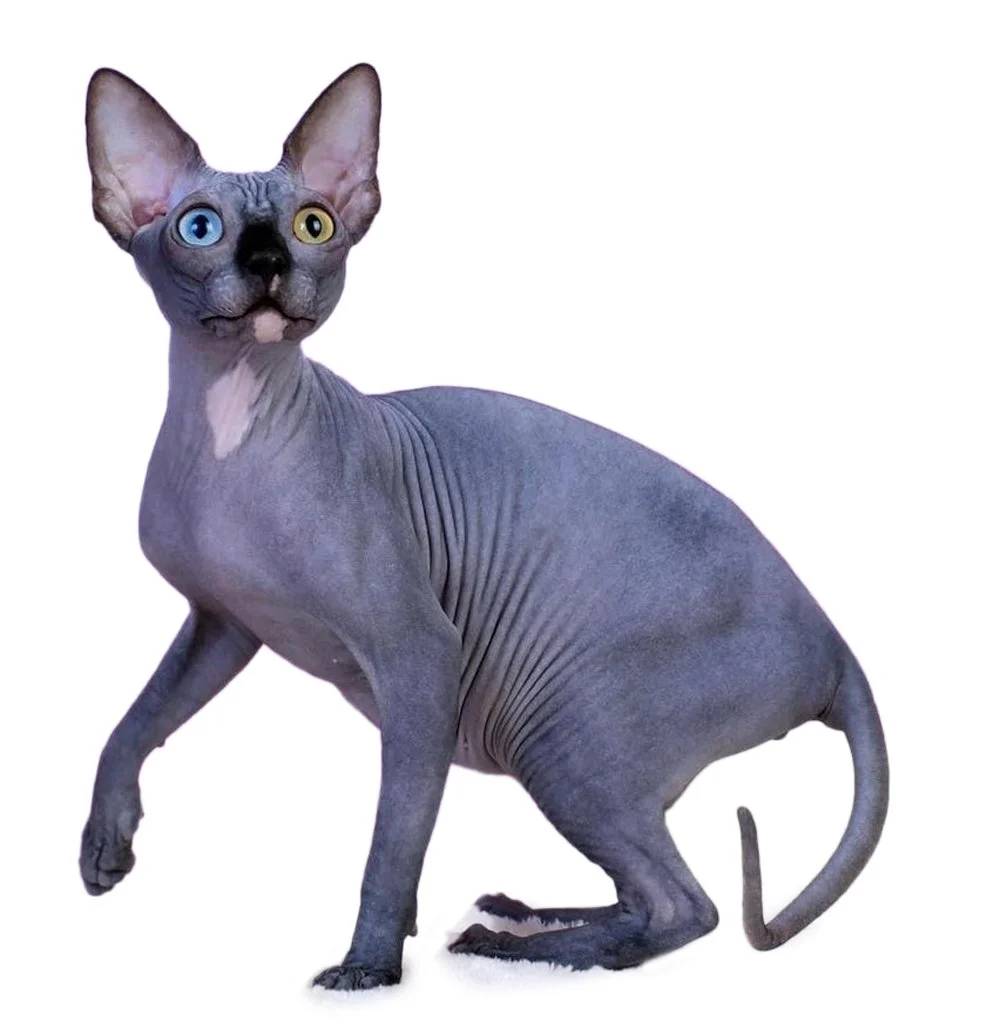
Sofia — genetically confirmed heterozygous DBE-CEL, black with minimal white and odd eyes (n 09 68 162)
Assigning specific Dominant Blue Eyes (DBE) variants to cats solely on the basis of photographs, visible phenotypes or pedigree interpretations, without supporting genetic evidence, is scientifically unjustified and potentially misleading.
Part I — Educational Context
DBE Genetics: Why Phenotype and Pedigree Cannot Establish Genotype
The Problem with Unsupported Genotype Assignments
We have personally witnessed and documented instances of specific DBE variants being assigned to cats based on photographs alone, including within private breeder groups and closed channels on platforms such as WhatsApp, Facebook and Discord.
The concern is not the discussion of possible genetic explanations, but the presentation of unverified assumptions as established genotypes, particularly when such conclusions may influence breeding decisions.
Different genetic mechanisms can produce similar appearances, while some genetically positive cats may not display the characteristic phenotype at all. Neither photographs nor pedigree records can establish a cat’s complete genotype.
Understanding the Genetics Behind Blue Eyes, Odd Eyes and White Pigmentation
Dominant White (W)
Dominant white is associated with the KIT gene and produces an entirely white coat by masking the cat’s underlying pigmentation.
Cats carrying dominant white may have blue eyes, odd eyes or non-blue eyes. Dominant white is also associated with an increased risk of congenital sensorineural deafness.
A dominant white cat may carry other pigmentation-related variants whose visible effects are concealed by its white coat. Consequently, an entirely white cat with blue eyes cannot be assumed to carry, or not carry, a particular DBE variant based on appearance alone.
White Spotting (ws)
KIT-associated white spotting produces areas of white pigmentation ranging from small markings to extensive patterns like bicolour, harlequin or van.
Blue eyes and odd eyes may also occur in cats with white spotting. However, neither the amount nor the distribution of white can reliably establish which genetic variants are present.
Dominant Blue Eyes (DBE)
Dominant Blue Eyes is not a single genetic variant.
Six distinct PAX3-associated variants have been identified and described in scientific research: DBE-CEL, DBE-ALT, DBE-RE, DBE-AGO, DBE-NAD and DBE-MARU. Other DBE-associated genetic mechanisms remain unresolved or insufficiently characterised.
Several DBE lineages show incomplete penetrance or variable expression. In practical terms, this means that some genetically positive cats may have no blue eyes, odd eyes or characteristic white markings, yet still transmit the variant to their offspring.
These characteristics have not been demonstrated to the same extent for every identified variant, and their health implications may differ.
When Pigmentation Variants Occur Together
Different pigmentation-related variants can coexist in the same cat, making interpretation from appearance particularly unreliable.
Dominant White and White Spotting
Dominant white and white spotting are associated with different alleles at the KIT locus.
In a simplified inheritance model, W represents dominant white, ws represents white spotting and w represents the allele without either effect. Possible combinations include W/W, W/w, W/ws, ws/ws, ws/w and w/w.
A cat with the W/W, W/ws or W/w combination may appear entirely white because dominant white masks the underlying spotting pattern. This simplified notation does not encompass every molecular variation affecting KIT.
Dominant White, White Spotting and DBE
A cat carrying dominant white or white spotting may also have a DBE-associated variant. A dominant white coat can conceal underlying pigmentation patterns, while blue or odd eyes cannot establish which genetic mechanism contributed to the eye colour.
Similarly, cats with white spotting may carry DBE, and the effects of these variants may overlap and increase the amount of white.
Multiple DBE Variants
The genetic possibilities are not limited to cats carrying a single copy of one DBE variant.
Depending on the variants involved, cats may carry two copies of the same variant or different DBE-associated variants. Where different variants affect the same gene, compound heterozygosity may also be relevant.
Some DBE-associated phenotypes include extensive white markings resembling harlequin or van patterns, or an entirely white appearance.
Not every theoretical combination has been documented or studied, and its effects on pigmentation, development or health cannot be predicted simply from the appearance of the parents.
These examples illustrate why two cats with similar phenotypes may have substantially different genetic backgrounds.
Why Pedigrees Cannot Establish Historical Genotypes
Pedigrees provide valuable information about ancestry, registered colours (if recorded correctly) and family relationships, but they do not provide a complete genetic record.
Most historical ancestors were never tested for DBE. Their registered colours and EMS classifications may also be incomplete, inconsistent or inaccurate.
A historical cat may have carried and transmitted a DBE variant without displaying blue eyes or other recognisable features. Conversely, blue eyes or odd eyes may have resulted from a different genetic mechanism.
Different DBE variants may also have entered the same pedigree through separate ancestral lines, making it impossible to determine their precise historical origins from genealogy alone.
This creates an important distinction that is often overlooked.
The presence of an ancestor associated with a particular DBE variant does not prove that a descendant inherited it. Equally, the absence of that ancestor or a known connection to the lineage does not establish that the descendant is genetically negative.
A breeder who assumes that a cat cannot carry DBE simply because a particular historical cat does not appear in its pedigree may be relying on an incorrect genetic conclusion.
Even when a living descendant has a laboratory-confirmed DBE variant, its pedigree cannot establish which untested ancestor introduced it. Alternative inheritance pathways, including the involvement of other DBE variants, may remain possible.
Why Accuracy in Genealogical Research Matters
The reliability of genealogical interpretations depends on the accuracy of the underlying records.
For example, describing cats registered under EMS 09 (unspecified amount of white) as bicolours, despite EMS 03 being the corresponding bicolour classification, introduces an inconsistency in the phenotypic information used for analysis.
Such distinctions matter when historical coat colours and eye colours are used to propose inheritance pathways.
Describing a publication as genealogical research or journalism does not remove the responsibility to verify information, accurately represent source records and distinguish documented facts from speculation.
Inaccuracies in registered names, inconsistencies in phenotypic classifications and unsupported assumptions about historical inheritance raise legitimate questions about the reliability of the conclusions drawn.
A proposed ancestral origin may be a reasonable hypothesis, but it should not be presented as a confirmed genetic finding without appropriate evidence.
Implications for Breeding Programmes
Incorrect assumptions about DBE status can have serious consequences for breeding decisions.
A phenotypically normal cat may carry and transmit certain DBE variants. If breeding decisions are based on appearance or an assumed absence of a particular ancestral line, genetically positive cats may remain unidentified.
This creates the possibility of unintentionally combining two copies of the same DBE variant or different DBE-associated variants. The consequences are not fully understood and may vary depending on the variants involved, including potential health risks.
Appropriate genetic testing is therefore important, particularly for cats from DBE-associated or genetically uncertain lines. However, a negative result only excludes the specific variants examined and cannot rule out variants that remain unidentified or are not included in the test.
Phenotypic observations and pedigree analysis can support genetic hypotheses, but they cannot replace molecular evidence when establishing a cat’s DBE status or making informed breeding decisions.
Part II — Official Statement
Genetic Accuracy, Privacy and the Use of Confidential Pedigree Records
We are issuing this statement to address inaccurate genetic information and unsupported genealogical conclusions published about our cat Sofia on independently operated websites, as well as concerns regarding the handling and disclosure of privately supplied pedigree information.
Sofia’s Confirmed Genetic Status
Sofia’s genetic status is not a matter of speculation.
She has been laboratory-confirmed as heterozygous N/DBE-CEL and tested negative for the examined DBE-ALT, DBE-RE and KIT dominant white and white-spotting variants.
Her genetic status was established in late 2024, and information about our cats’ confirmed DBE status was publicly disclosed on 6 January 2025 on our website and social media.
Her official GCCF registration reflects her confirmed DBE-CEL status.
What remains unconfirmed is the precise historical origin of DBE-CEL within her ancestry. No genetic testing of the relevant historical ancestors has established where the variant entered her lineage.
Background and Anonymisation
In December 2024, we privately supplied a photograph of Sofia’s certified TICA pedigree to an independent researcher. In January 2025, we provided an additional photograph of a pedigree issued by WCF.
The distinction between these documents is important. While the TICA pedigree used written colour descriptions, such as “black/white”, the second pedigree contained specific EMS codes identifying the registered phenotypes of Sofia’s ancestors. This information was particularly relevant to reconstructing and interpreting her extended genealogical tree.
Neither of these pedigree documents, nor the detailed genealogical and phenotypic information contained in them, had ever been made publicly available by us.
Sofia’s certified pedigrees were provided privately for research and publication purposes. In the accompanying correspondence, we expressly requested that her microchip number, registration number and the name of the Russian breeder identified in the document should not be disclosed, while explicitly permitting the use of our own cattery name. The email and its attachments were also marked as confidential and intended for the addressed recipient.
On 6 March 2025, we requested anonymisation of our personal information, cattery name and cats’ identifying details for privacy and personal safety reasons, including documented concerns involving breeder impersonation, cloned websites, fraudulent kitten advertisements and the potential misuse of registration and pedigree information.
These concerns were not hypothetical. Photographs and other materials from our website had been scraped and reused to create cloned websites, impersonating Facebook pages and fraudulent kitten advertisements.
In these circumstances, the disclosure of complete pedigree records presented an additional security risk. Access to a cat’s full registered name, registration details and extended genealogy could provide individuals engaged in breeder impersonation with information useful for fabricating convincing registration certificates, pedigrees or other documents falsely representing cats as originating from a legitimate breeding programme.
Our request was also motivated by other serious circumstances, including identity fraud, which remain the subject of an ongoing police investigation in Scotland, in which we are the victims. For legal and personal safety reasons, we do not intend to disclose further details publicly.
The researcher subsequently anonymised the publication on 7 March 2025 and the associated genealogical tree in response to our request. On 11 March 2025 — five days after requesting anonymisation — we provided the researcher with the genetic test certificates of Sofia's offspring, each confirming heterozygous N/DBE-CEL status. These were shared in good faith, in the same trust in which all previous documentation had been provided. This is not consistent with an intention to conceal genetic information. Anonymisation was requested for personal safety reasons, not to restrict access to genetic findings.
Subsequent Publication and Disclosure of Information
Approximately 18 months later, we discovered that Sofia’s extended genealogical tree had been reconstructed and published in an independently operated online pedigree directory, accompanied by information corresponding to our privately supplied records.
The original directory entry referred to an image of Sofia’s certified TICA pedigree, disclosed its exact print date and stated that her registration number was held in the directory’s private database.
At the time, the complete certified TICA pedigree had only been provided by us to GCCF for registration purpose and to the original research recipient.
We had never published the complete document online, supplied it to the directory operator or authorised its onward disclosure.
When we contacted the original research recipient, they confirmed in correspondence that background information and photographs of most DBE breeds had been shared with the directory operator on a confidential basis and were not intended for publication.
We had not been informed of this sharing and had not provided specific authorisation for it.
When we raised concerns about the sharing of information without our knowledge or authorisation, our objections were characterised as excessive secrecy and portrayed as contrary to transparency and the responsible exchange of genetic information.
We reject that characterisation. Our concerns related to confidentiality, personal safety and the accuracy of published information, not to preventing legitimate research.
Following our subsequent correspondence in October 2026, the researcher reversed the anonymisation previously carried out at our request in March 2025, and added a public statement suggesting that genetic information was being withheld, inviting readers to draw their own conclusions.
This implication is misleading. Our cats’ laboratory-confirmed DBE-CEL status had been publicly disclosed in January 2025 and was never concealed.
Participation in research does not amount to unrestricted permission to disclose confidential breeding records.
While the correspondence confirms that background information and photographs were shared with the directory operator, we have not independently established the complete chain through which the certified pedigree information reached the directory.
Published Inaccuracies
The online pedigree directory published information describing Sofia as genetically untested and the origin of her eye colour as undetermined, despite her confirmed DBE-CEL result.
Both publications relied on the same historical ancestor when interpreting Sofia’s eye colour, although their explanations differed. One suggested that DBE-CEL may have remained unrecognised in historical blue-eyed white cats, while the other attributed Sofia’s odd-eyed phenotype to dominant white recorded in her ancestry, without acknowledging her laboratory-confirmed DBE-CEL status.
Neither interpretation establishes the genotype of the historical ancestor or the precise ancestral origin of Sofia’s confirmed DBE-CEL variant.
The possibility that DBE entered the pedigree through another ancestral line, or that more than one pigmentation-related variant was present, cannot be excluded by phenotype-based genealogy alone.
We distinguish legitimate hypotheses from conclusions presented with a degree of certainty that the available genetic evidence does not support.
Inaccurate Registration and Phenotypic Descriptions
The first researcher’s publication also included an incorrect version of Sofia’s registered pedigree name and inaccurately described her three offspring as bicolours.
All three offspring are officially registered under EMS 09 (unspecified amount of white), not EMS 03 (bicolour).
The publication also described Sofia as a bicolour while displaying her EMS code containing 09.
These are distinct classifications. EMS 09 is used for unspecified amounts of white, usually less than 25% whereas EMS 03 identifies a bicolour pattern with white around 30-50% of the body covered. This inconsistency is particularly relevant in a publication that relies on historical pigmentation patterns to interpret possible genetic inheritance.
When genealogical conclusions depend on recorded pigmentation patterns, inaccuracies or inconsistencies in those records must be acknowledged rather than treated as reliable genetic evidence.
The use of information for research or so-called “journalistic purposes” does not, by itself, establish its accuracy. Responsible publication requires source verification, correct representation of registration records and a clear distinction between confirmed findings and proposed explanations. It also requires adherence to fundamental principles of journalistic ethics, including the protection of sources and the minimisation of harm.
Our Position
We support legitimate genetic research, responsible pedigree investigation and the sharing of scientifically verified findings.
We do not support assigning specific genetic variants to cats based solely on photographs, presenting historical genealogical hypotheses as confirmed genotypes, or disclosing confidential breeding records contrary to communicated restrictions.
Pedigree information may also constitute personal data where it enables individuals to be identified directly or indirectly through breeder prefixes, registration records and other publicly accessible information.
Our request for anonymisation was made for legitimate privacy and personal safety reasons. It was not an attempt to interfere with research or conceal genetic information.
We have deliberately chosen not to identify the websites or their operators in this statement. Our intention is to address factual inaccuracies, questionable genetic interpretations and concerns surrounding the handling of confidential information, rather than give further visibility to the publications concerned.
Genetic findings must be distinguished from genealogical hypotheses, and privately supplied information must be handled responsibly, accurately and in accordance with applicable data protection obligations.
These principles should apply consistently to everyone involved in feline genetics, pedigree research and breeding.
Published on 21 October 2026