How breeding cats are housed matters more than buyers realise
I’ve seen a lot of discussion recently about biosecurity in breeding homes and, in particular, the suggestion that allowing breeding cats to live freely in the home somehow puts them at greater risk of infectious disease.
And of course biosecurity is necessary; cats can carry infections without showing obvious symptoms, new animals should be quarantined, sick cats may need to be isolated and a queen with newborn kittens needs to be protected. Good hygiene, vaccination, testing where necessary and sensible handling of different groups of cats are all fundamental parts of running a breeding programme.
But I think there are two completely different things being mixed here.
Isolation when necessary is not the same as the practice of keeping healthy cats in small enclosed units for a prolonged period. And simply prefixing the word ‘biosecurity’ to the practice does not somehow make it into good welfare.
If I take a new cat into my house, and that cat has to be quarantined, it goes into a separate room, which can be closed off from all the others in the house. It has its own bowls, litter tray, bedding and cleaning supplies. If there is a genuine infection concern, I can keep separate clothing and cleaning supplies for that room, disinfect where necessary and take whatever other precautions are appropriate before moving between areas.
Not one of them requires that the cat should be locked up in a cage.
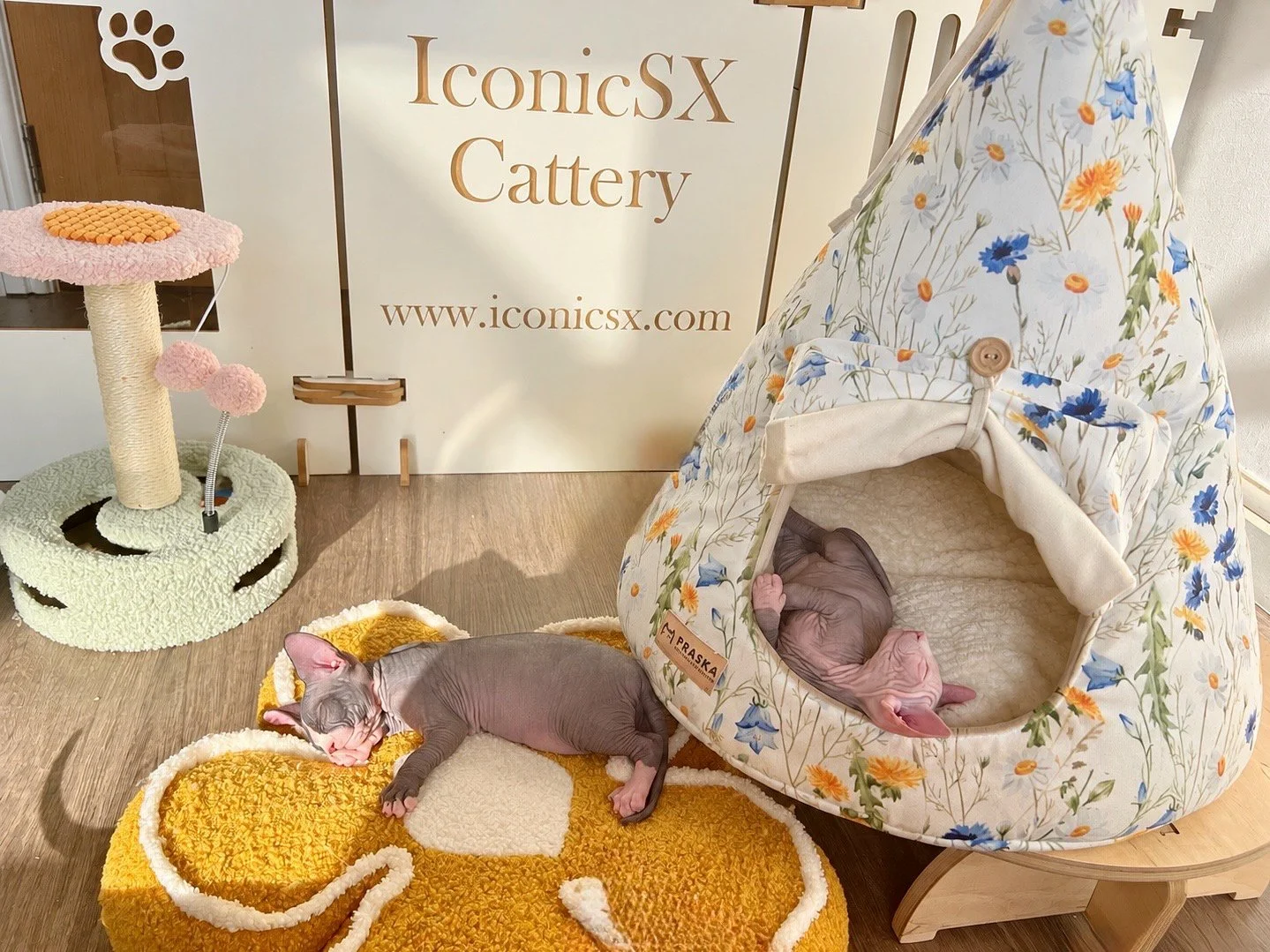
The cat is still able to stretch out, climb onto shelves, make use of scratching posts, sleep in different places, watch birds, enjoy the sun, hide when it wishes to and move away from its litter tray. Its water and food can be kept separately, rather than all being cramped up in the same corner for lack of space.
European Responsible Cat Breeding Guidelines recommend a minimum separation of at least 60 cm between the most important items such as food, water, litter, resting and hiding places. The word minimum is important here, because this is not a higher welfare standard and it certainly isn’t enrichment. It is a basic separation which allows the cat to distinguish between where it eats, drinks, sleeps and toilets.
The guide clearly says that the critical minimum amount of space required for good feline welfare has not been established, and that the dimensions given are minimum sizes which should preferably be exceeded. The same guidelines also advise against keeping cats for long periods in cattery-style pens. In a home environment, cats should only be confined to an indoor cage or kennel for short periods because of illness and under veterinary advice. Cats should also not be housed in tiered or stacked pens.
Reaching the minimum does not mean that a breeder has created an excellent environment. It means just what it says: the breeder has reached the minimum.
In this respect too, the regulations for licensed breeders of cats in Scotland are interesting. Under the regulations, cats kept in a domestic setting must have access to more than one room, a separate sleeping place and the possibility of taking exercise. If instead of this a more enclosed system is used, the standards lay down minimum dimensions and stipulate that there must be a suitable exercise space or access to a secure exercise space.
These are indeed the minimum dimensions laid down by the Scottish Government as minimum cage/enclosure sizes. For a single adult cat, the minimum total area is 2.5 m², and the minimum height is 1.8 m. There must also be room for the cat to stand upright on its hind legs, lie fully stretched, turn around and walk without touching another cat or the walls.
Again, they are minimum dimensions for licensing purposes, but not a description of an excellent state of well-being, and I am certainly not of the opinion that breeders should make this a target to work down towards.
There is a world of difference between an enclosure which in a technical sense complies with a minimum standard and deciding that for a healthy cat to be confined in that enclosure for weeks, months, or for essentially the whole breeding life of the cat, must constitute good housing.
Likewise enrichment. If the litter tray, food, water and bed can only just fit in the space available, adding a shelf and a scratching post doesn’t suddenly make it an enriched environment. Even the veterinary hospital has to provide for cats that need to stay, and these are sick animals that are temporarily housed for treatment or observation.
A healthy breeding cat is not a hospital patient.
Moreover, I find comparisons between breeders and animal hospitals or shelters of little relevance when it comes to justifying keeping a healthy breeding cat in a small enclosure.
An animal hospital doesn’t choose how many animals come through its door each day, and a shelter cannot control the health or the background of each cat that crosses its threshold. But a breeder can.
We know how much space we have before we make our decisions. We decide on the number of cats we keep, on the number of males and females we will leave intact, on how many litters we want to produce and whether we will bring in any other animal.
And population size is part of biosecurity too. We can’t talk about the infection risk of cats living together while ignoring how many cats we have chosen to put into that environment in the first place. If the only way to conduct a breeding programme is to continuously separate healthy animals into small enclosed units, then maybe it isn’t the cats’ normal life that is unsafe.
Perhaps there are simply too many cats for the available space.
This is particularly important when breeders whose cats lead an ordinary life in their own house are portrayed as less responsible, or as if allowing the cats to live freely is simply marketing.
The spread of disease in a multi-cat household cannot be reduced to a single criterion. The number of cats matters, but so do space, hygiene, vaccinations, ventilation, stress, how the cats are grouped and how often someone new enters the house. So reducing the whole issue to whether the cats live together or in individual cages seems a little odd to me.
I am not for a moment denying that there is a necessity for separating cats when there is a reason for it. I will separate a sick cat, and I will never expose a litter of newborn kittens to cats that they don’t need to meet. I regard this as normal biosecurity.
I only disagree when people think they can use those conditions to justify the routine cramming of healthy cats into small individual enclosures. It is not the same thing.
EFSA also looked at this in its 2023 opinion on welfare in commercial dog and cat breeding establishments. Space, group size and enrichment were all considered, along with the welfare problems that may arise from inadequate housing, including restricted movement and behaviour, fear, anxiety and boredom.
And I think something else has been confused in this conversation. A confined cat should certainly have a scratching post, a comfortable place to sleep, a shelf and somewhere to hide, but all that doesn’t make up for lack of space. Putting enrichment in the enclosure and providing an enriched environment are two different things.
Cats must be able to use their surroundings.
They need somewhere to climb, somewhere to hide, room to play and move properly, different places to rest and enough space between their resources that eating, sleeping and toileting are not all happening almost on top of each other. They also need some choice over where they spend their time.
Even the Scottish licensing guidance, when talking specifically about cats housed in enclosures, includes climbing or jumping onto different levels, scratching and play, as well as exercise for physical and mental health.
Then there is the question of numbers.
As breeders, we decide how many cats we keep. We decide whether to keep another kitten, bring in a stud male, add another female or have another litter. We also know how much room we have available.
This was actually something discussed in the breeder education I completed years ago. A cattery has a finite amount of space, and it is the breeder who decides which new cats are brought into it. The cats don’t decide how large the group becomes. We do.
For my part, if keeping one more breeding cat meant that one of mine had to spend most of its life in a small enclosure because I had run out of suitable space, then I would not want to have that cat. I do not see that a new enclosure creates any more space, it only makes it possible to fit another cat in that space.
The way I see it, the relationship should be the other way around: the number of cats must fit the home and facilities available, rather than the cats having to fit into progressively smaller spaces because the breeding programme has grown.
Queens are a good example because they genuinely do need to be separated at certain times.
Mine have their own nursery for birth and the first weeks with their kittens. They have privacy, but they aren’t shut in a cage. Mum can walk around the room, sleep somewhere else, scratch, use her litter tray away from her food and leave the nest when she has had enough of the kittens for a while.
The babies themselves obviously need to be contained when they are tiny. Anyone who has raised a litter knows how quickly that changes though. One minute they are potatoes in a nest and not long afterwards they are climbing, running, playing and trying to get absolutely everywhere. Keeping them safe doesn’t require keeping their mother in the same small space with them.
Scottish licensing guidance actually says that a birthing area should be private, quiet and safe, while also allowing the queen to move away from both the heat source and her kittens if she wants to. I think that is a pretty sensible way of looking at it. And again, this is a minimum requirement. It is the baseline a licensed breeder is expected to provide, not an example of exceptional welfare.
My own expectations were also shaped quite heavily by the breeder education I had. On the Campus Felinarium course I completed, the guidance we were given was at least 10 m² per cat and 20 m² for a queen with her kittens. That stayed with me, probably because the whole conversation was about how much space cats actually need to live properly, rather than how little space could technically be considered acceptable.
I think there may be a cultural element to some of this too. A lot of the breeders and mentors I learned from were European, and routinely keeping healthy breeding cats in cages or small enclosures simply wasn’t seen as something to be proud of.
A queen having her own room was normal, a stud might have his own suitable part of the house and a newly arrived cat could have a separate room for quarantine.
There was nothing unusual about separating cats when it was needed. The difference was that separation didn’t automatically mean confinement.
You can separate cats without putting them in cages.
There are times when one of my cats needs more restriction than usual. After surgery, for example, I may need to stop them jumping around for a while, and illness can mean keeping a cat completely separate from everyone else. I deal with whatever the actual problem is. If the cat needs a room with no furniture to jump onto, that is what I arrange. If a vet says movement needs to be restricted in a particular way, then obviously that is what happens.
But those are individual situations with an actual reason behind them. They aren’t the normal living arrangements of a healthy cat.
And that really is what I am talking about here. Not a carrier used to take a cat to the vet, not keeping tiny kittens safely in their nest, not a cat recovering from surgery and not temporary isolation because of infection.
I mean a healthy breeding cat living like this routinely, for weeks, months or for the entire breeding life, because that is simply where the breeder keeps it.
Calling a cage an enclosure, or 3 m² a luxury condo, doesn’t change what the cat experiences. If most of its world consists of a bed, litter tray, bowls, a shelf and a scratching post all within a few square metres, that is still most of its world.
For me, good biosecurity has never meant trying to remove normal life from the cats. It means being sensible about introductions, quarantine, illness, hygiene, vaccination, testing and how the cats are managed. Those things are perfectly possible without routinely keeping healthy cats in cages.
And if a breeding programme cannot provide both good biosecurity and good welfare within the space available, the answer is not another cage.
It is a smaller breeding programme.
`#SphynxCats #CatWelfare #SphynxLife #CatCare #HairlessCats #SphynxKitten #CatEducation #ResponsibleBreeding #CatHealth #KnowYourBreeder`