First DBE Celestial in Sphynx Breed Confirmed.
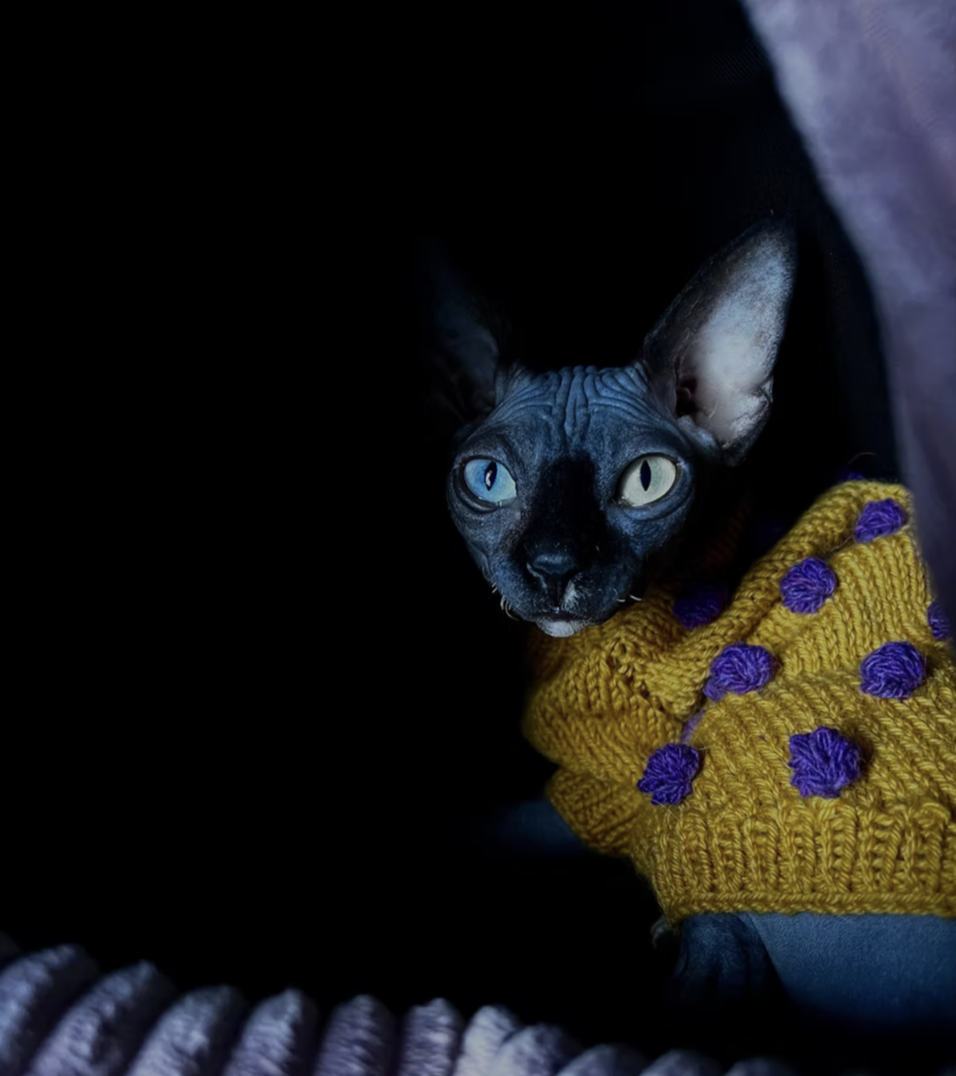
IconicSX Cattery is home to the first Sphynx cat with a genetically confirmed DBE Celestial gene.
Our queen Sofia is heterozygous N/DBE-CEL — carrying one copy of the Celestial variant of the Dominant Blue Eye gene. This is one of the best-studied and safest DBE variants identified to date.
What is DBE-CEL?
The DBE-CEL gene was previously grouped under the broader DBE-Altai classification. In 2024, Professor Marie Abitbol formally identified and distinguished it as a separate variant with its own genetic mechanism. It is autosomal dominant — one copy is sufficient for expression, producing blue or odd-coloured eyes.
What sets DBE-CEL apart from other DBE variants is its documented safety profile:
No association with deafness. No link to Waardenburg-like symptoms. No dystopia canthorum — a key diagnostic feature of Waardenburg Syndrome Types 1 and 3 — has been observed in DBE-CEL cats.
From the published research:
“Dystopia canthorum was not observed in adult DBE cats from Altai, Celestial, British, Sphynx, and Siberian genetic backgrounds. The variant (DBE-CEL) was found in the Celestial breed and has not been associated with deafness.”
— Abitbol et al., Different Founding Effects Underlie Dominant Blue Eyes (DBE) in the Domestic Cat, Animals (Basel), 2024.
Why the distinction between DBE variants matters
DBE is not a single mutation. It is a group of independently identified, genetically unrelated variants. Each has its own mechanism, its own expression, and its own risk profile. Treating them as one thing is a scientific error — and a dangerous one for breeding decisions.
The currently identified variants include:
DBE-Celestial (DBE-CEL) — affects iris pigmentation only. No documented health risks in heterozygous form. No involvement in neural crest pathways.
DBE-Altai (DBE-ALT) — structurally neutral based on current evidence.
DBE-Rociri Elvis (DBE-RE) — linked to deafness and Waardenburg-like syndrome. This variant operates through a different genetic mechanism (PAX3) and carries documented health risks.
These are not interchangeable. Crossing different DBE variants — for example, combining DBE-CEL with DBE-RE — without genetic testing can produce offspring with compounded risks, including traits resembling Waardenburg Syndrome. Some DBE mutations are also homozygous-lethal, meaning kittens inheriting two copies may not survive to term.
This is why genetic testing is not optional when working with blue-eyed cats. Without knowing which variant is present, no breeder can make a safe pairing decision. Breeding blue-eyed cats based on phenotype alone — because the eyes look blue — without confirming the underlying genotype is reckless, regardless of how experienced the breeder claims to be.
What we do
None of our breeding cats carry the DBE-RE variant. All have been tested and confirmed.
All DBE and odd-eyed cats in our programme undergo BAER (Brainstem Auditory Evoked Response) testing to confirm hearing status. Every DBE kitten leaves our cattery with a genetic certificate confirming their specific DBE variant — not just “blue-eyed,” but which gene and in what form.
This level of documentation exists because it should. If a trait is safe, it should be provable. If a variant is confirmed, the confirmation should travel with the cat.
Acknowledgements
This work would not have been possible without Professor Marie Abitbol, whose research identified and classified the DBE-CEL variant, and who invited IconicSX to participate in her research project — advancing our collective understanding of these genes.
Our thanks also to Sarah Hartwell for her long-standing work classifying and organising genealogical data for DNA studies, which remains an invaluable resource for the breeding and scientific communities.
Further reading
Blue-eyed Sphynx and the DBE-CEL gene: messybeast.com/blue-eyes-waardenburg.htm
DBE Gene information: iconicsx.com/dbe