GENES DON’T LIE — White Isn’t Just a Colour.
Imagine this:
You’ve got a full painting underneath — rich colours, perfect patterns, a story written in genes.
Black, blue, tortie…maybe even a classic tabby.
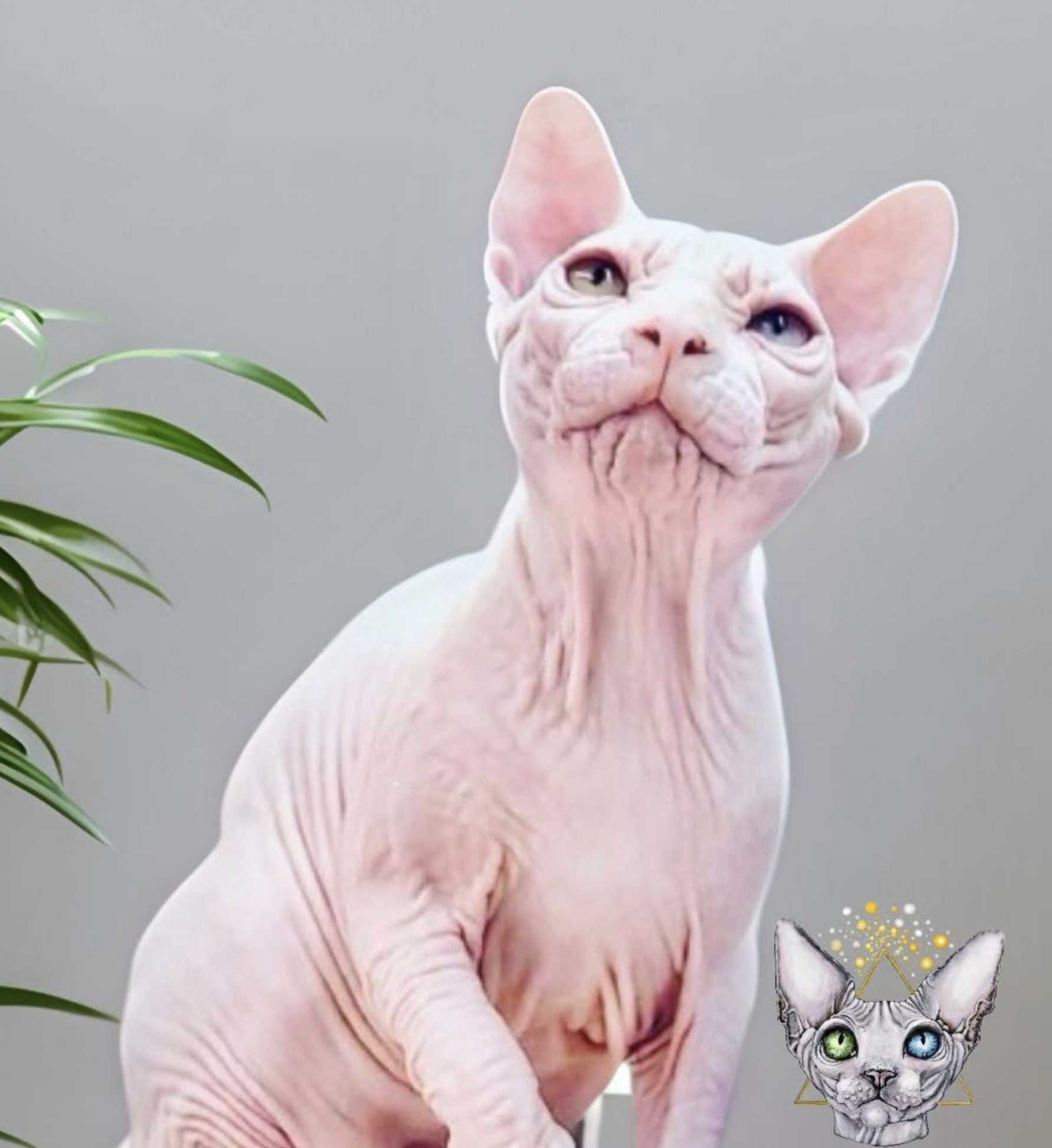
On photo: Bailey - our very first male Sphynx. White, odd eyes, and a perfect example of why genetics matter.
But then?
Someone pulls a pure white curtain over the whole canvas. And just like that — poof. It’s all gone.
That’s what the white gene (symbol: W) does. It’s not really a colour gene in the traditional sense. It’s more like a genetic blackout.
Let’s talk about it.
What does it do?
Just one copy (w/W) is enough to turn the cat fully white. Two copies (W/W) Still white — but with increased risk of something more serious.
The link to deafness
The same gene that blocks pigment in the fur… also affects how pigment cells travel in the body — including to the inner ear.
No pigment in the cochlea = no sound.
That’s why white cats — especially those with blue or odd eyes — are more likely to be deaf in one or both ears.
Did you know?
White cats with two blue eyes: 50–65% chance of deafness
Odd-eyed whites: ~30–40% risk
Even yellow-eyed whites: up to 20% may still be affected
And in odd-eyed cats, the blue eye side is often the deaf side.
Waardenburg-like syndrome?
Yes — cats don’t get the human version of Waardenburg Syndrome exactly, but they can show similar features when the pigment pathways are disrupted.
Genes like PAX3, SOX10, EDNRB and MITF (involved in pigment migration) have been linked to both colour expression and hearing development — especially when KIT (W, ws genes) is involved.
In cats, these combinations can lead to:
Blue Eyes
Odd eyes
Asymmetrical pigment
Partial or full deafness — even in cats that aren’t genetically white
That’s why BAER testing isn’t just for whites
It matters in some high-white spotted cats too (more on that soon in Part 4).