
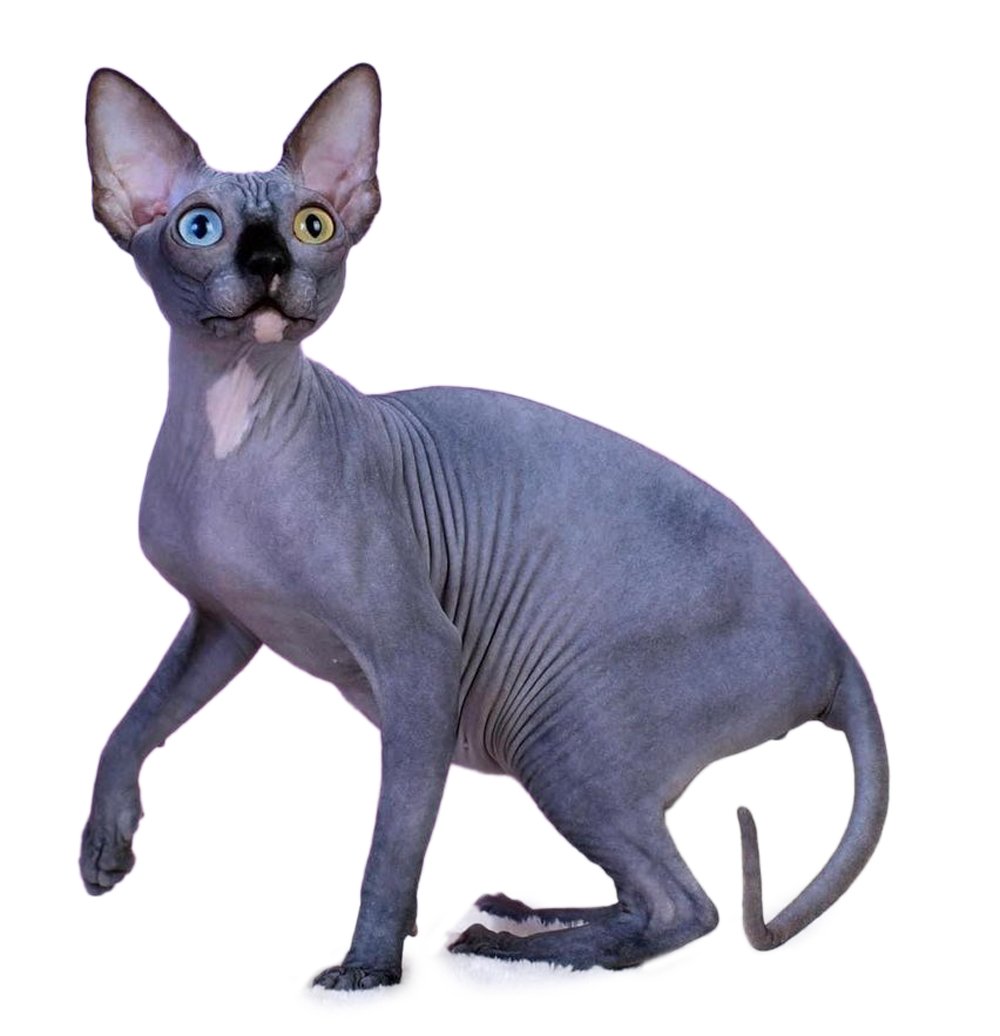
MirMagnificent Y* Sofia (n 09 68 162)
IconicSX Cattery is home to the first Sphynx cat with a genetically confirmed DBE Celestial gene.
Our queen MirMagnificent Y*Sofia, also known as Sofia of IconicSX, is genetically confirmed as heterozygous N/DBE-CEL, carrying one copy of the Celestial variant associated with Dominant Blue Eyes. Based on currently published research, heterozygous DBE-CEL is among the best-studied DBE genotypes and has one of the most favourable documented hearing-health profiles, with no established association between the variant and congenital deafness in heterozygous cats (Abitbol et al., 2024; 2025).
Sofia has also tested negative for DBE-ALT and DBE-RE, as well as the tested KIT Dominant White (W) and White Spotting (ws) variants. Both W and ws have also been genetically excluded in her offspring, all three of whom have confirmed DBE-CEL status.
Based on her laboratory-confirmed genetic results, GCCF issued Sofia’s registration certificate recording her DBE-CEL status under the EMS code n 09 68 162. This classification identifies her as a black Sphynx with a small amount of white (09), odd eyes (68) and the genetically confirmed DBE-CEL variant (162).
Sofia has also undergone BAER (Brainstem Auditory Evoked Response) testing, confirming normal hearing in both ears. Her GCCF registration, molecular genetic results and bilateral BAER findings provide documented evidence of her registered phenotype, genetic status and hearing function.
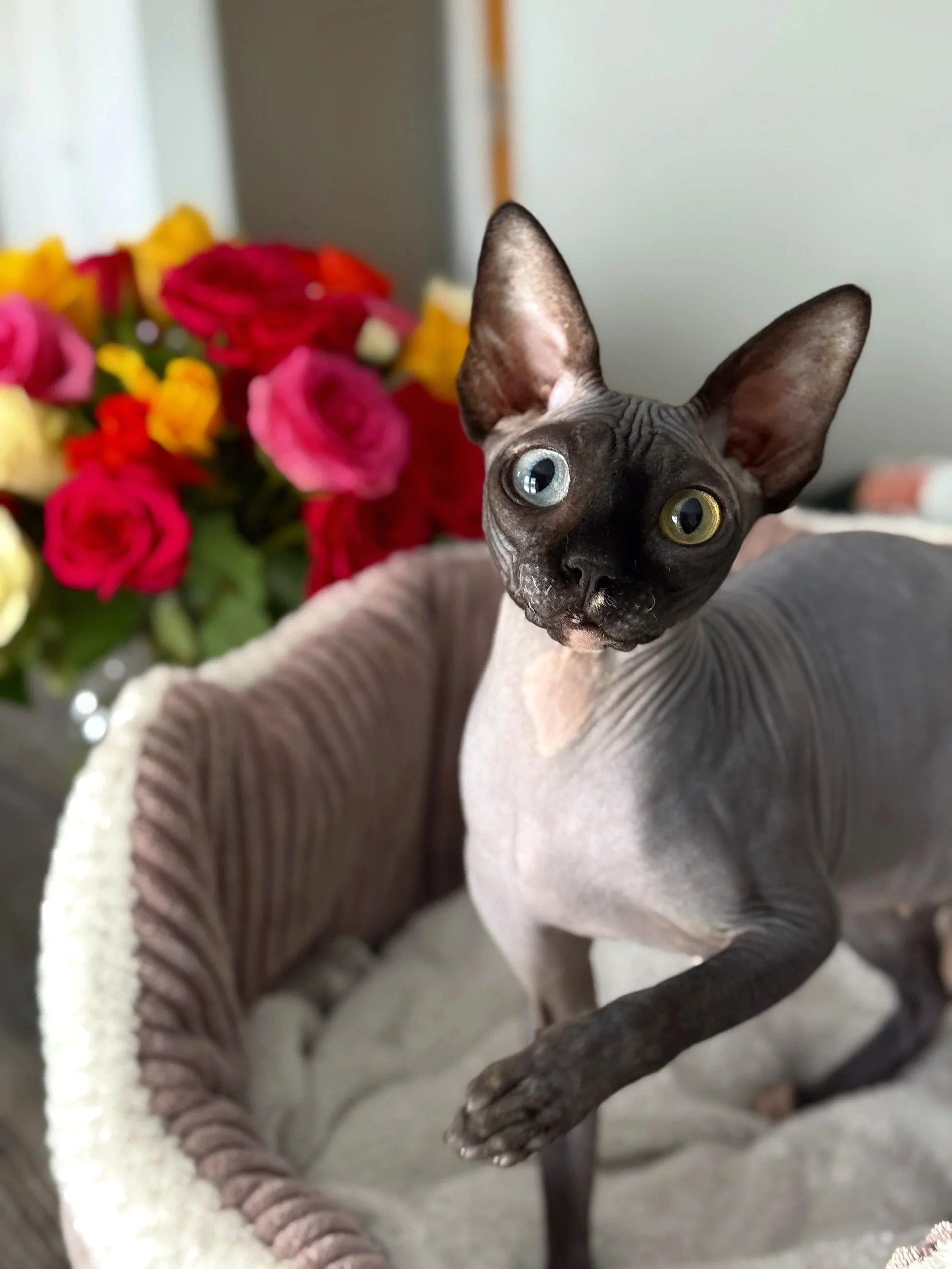
SOFIA
What is DBE-CEL?
The DBE-CEL gene was previously grouped under the broader DBE-Altai classification. In 2024, Professor Marie Abitbol formally identified and distinguished it as a separate variant with its own genetic mechanism. It is autosomal dominant — one copy is sufficient for expression, producing blue or odd-coloured eyes.
What sets DBE-CEL apart from other DBE variants is its documented safety profile:
No association with deafness. No link to Waardenburg-like symptoms. No dystopia canthorum — a key diagnostic feature of Waardenburg Syndrome Types 1 and 3 — has been observed in DBE-CEL cats.
From the published research:
“Dystopia canthorum was not observed in adult DBE cats from Altai, Celestial, British, Sphynx, and Siberian genetic backgrounds. The variant (DBE-CEL) was found in the Celestial breed and has not been associated with deafness.”
— Abitbol et al., Different Founding Effects Underlie Dominant Blue Eyes (DBE) in the Domestic Cat, Animals (Basel), 2024.
Why the distinction between DBE variants matters
DBE is not a single mutation. It is a group of independently identified, genetically unrelated variants. Each has its own mechanism, its own expression, and its own risk profile. Treating them as one thing is a scientific error — and a dangerous one for breeding decisions.
The currently identified variants include:
DBE-Celestial (DBE-CEL) — affects iris pigmentation only. No documented health risks in heterozygous form. No involvement in neural crest pathways.
DBE-Altai (DBE-ALT) — structurally neutral based on current evidence.
DBE-Rociri Elvis (DBE-RE) — linked to deafness and Waardenburg-like syndrome. This variant operates through a different genetic mechanism (PAX3) and carries documented health risks.
These are not interchangeable. Crossing different DBE variants — for example, combining DBE-CEL with DBE-RE — without genetic testing can produce offspring with compounded risks, including traits resembling Waardenburg Syndrome. Some DBE mutations are also homozygous-lethal, meaning kittens inheriting two copies may not survive to term.
This is why genetic testing is not optional when working with blue-eyed cats. Without knowing which variant is present, no breeder can make a safe pairing decision. Breeding blue-eyed cats based on phenotype alone — because the eyes look blue — without confirming the underlying genotype is reckless, regardless of how experienced the breeder claims to be.
What we do
None of our breeding cats carry the DBE-RE variant. All have been tested and confirmed.
All DBE and odd-eyed cats in our programme undergo BAER (Brainstem Auditory Evoked Response) testing to confirm hearing status. Every DBE kitten leaves our cattery with a genetic certificate confirming their specific DBE variant — not just “blue-eyed,” but which gene and in what form.
This level of documentation exists because it should. If a trait is safe, it should be provable. If a variant is confirmed, the confirmation should travel with the cat.
Acknowledgements
This work would not have been possible without Professor Marie Abitbol, whose research identified and classified the DBE-CEL variant, and who invited IconicSX to participate in her research project — advancing our collective understanding of these genes.